Key Takeaways
- Product Manager CVs need metrics that prove impact – not just a list of features you shipped.
- Software Engineer resumes should balance technical depth with readability (yes, recruiters who can't code will read it first).
- Marketing Manager CVs live or die by campaign results and growth numbers.
- Each role has different ATS keywords that matter – generic resumes get binned immediately.
- Your LinkedIn profile contains 80% of what you need... if you know how to structure it.
Ready to stop guessing? Paste your LinkedIn profile link – build an ATS-optimized CV in 5 minutes with Linked CV Builder.

Look, I've seen hundreds of CVs. Maybe thousands at this point. And here's what nobody tells you: the format matters less than you think, but the content structure matters way more than you realize.
Most people write their CV like they're documenting their job description. That's not what hiring managers want to see. They want proof you can do the job they're hiring for, not proof you showed up to your last job.
Let me break down what actually works for three of the most competitive roles out there.
Product Manager CV: Show Me the Impact
Product managers have this weird problem. Their job is... kind of everything? And nothing at the same time. You're not writing the code, you're not designing the interface, you're not closing the deals. So what exactly do you put on a CV?
Here's what works:
Skip the fluff about "cross-functional collaboration" and "stakeholder management." Everyone says that. It means nothing anymore.
Instead, structure each role like this:
- Company name, dates (obviously).
- One line on what the product actually was – context matters.
- 3-4 bullets of measurable outcomes.
The bullets should follow this pattern: "Led [specific initiative] that resulted in [metric] by [doing what]."
Real example that works: "Launched pricing optimization feature that increased average contract value by 34% across 200+ enterprise accounts by implementing usage-based tiers and grandfather clauses for existing customers."
See the difference? That's not "managed product roadmap" or "collaborated with engineering teams." That's proof you made something happen.
For product managers, your CV should answer one question: did you make the product better in ways that mattered to the business? Revenue up, churn down, adoption up, costs down. Pick your metrics and own them.
Also – and I cannot stress this enough – if you're applying to B2B product roles, don't lead with consumer product experience unless the skills directly transfer. Recruiters pattern-match faster than you think.
Software Engineer CV: Technical Without Being Unreadable
Engineers have the opposite problem. You want to show technical depth, but the first person reading your CV is probably a recruiter who doesn't know the difference between React and Redux.
Here's the thing... your CV needs to work on two levels. Surface level for the recruiter (can this person code in our stack?), deep level for the hiring manager (is this person actually good?).
The tech stack section matters more than you think. Put it near the top. Languages, frameworks, tools, cloud platforms. Make it scannable. Use the exact terms from the job posting because ATS systems are dumb and literal.
But here's where most engineers mess up: they list technologies without showing what they built with them.
Instead of this: "Developed features using React, Node.js, and PostgreSQL"
Try this: "Built real-time notification system handling 50K concurrent users using React, WebSockets, and Redis, reducing page load time from 3.2s to 800ms"
The technical details prove you know your stuff. The metrics prove it mattered.
One more thing: if you're a senior engineer, your CV should show architecture decisions and mentorship. Junior engineers write code. Senior engineers make decisions about how systems should work and help others get better. Your CV should reflect that shift.
And please, for the love of all that is good, don't make your CV a GitHub README. No ASCII art, no clever formatting that breaks ATS systems, no cute jokes in the header. Save that for your personal site.
Marketing Manager CV: Numbers, Numbers, Numbers
If you're a marketing manager and your CV doesn't have percentages in almost every bullet point, start over.
Marketing is the most measurable department in most companies now. Everything is tracked – clicks, conversions, CAC, LTV, engagement, you name it. Your CV should reflect that reality.
The structure that works:
- Campaign or initiative name.
- Your specific role (did you lead it or just contribute?).
- The results in hard numbers.
Example: "Designed and executed Q4 demand gen campaign across paid social, email, and content that generated 1,200 qualified leads at $45 CAC, 40% below target, resulting in $2.3M pipeline"
That sentence tells me: you can plan campaigns, you know multiple channels, you understand unit economics, and you delivered results. That's what hiring managers are looking for.
Here's what doesn't work: vague statements about "increased brand awareness" or "improved engagement." Awareness of what? Engagement measured how? Be specific or be ignored.
Also, tailor your metrics to the role you're applying for. If it's a growth marketing role, lead with acquisition and conversion metrics. If it's brand marketing, talk about reach, sentiment, and brand lift studies. If it's product marketing, show how your launches performed and how you influenced product direction.
One mistake I see constantly: marketing managers listing every tool they've ever touched. "Proficient in HubSpot, Marketo, Salesforce, Google Analytics, SEMrush, Ahrefs..." Cool, but so is everyone else. Instead, show what you accomplished using those tools.
The Stuff That Applies to All Three Roles
Okay, some universal truths that work across product, engineering, and marketing CVs:
Length: Two pages max. One page if you have under 5 years of experience. Nobody's reading three pages, I don't care how impressive you think your career is.
Formatting: Clean, scannable, boring. Use a standard font. Left-align everything. Consistent spacing. This isn't the place to show your design skills.
Buzzword bingo: Every field has overused phrases that make recruiters' eyes glaze over. For product it's "data-driven" and "user-centric." For engineering it's "passionate about code" and "fast learner." For marketing it's "creative thinker" and "results-oriented." Just delete these. Show the work instead.
Education section: Unless you went to Stanford or MIT, or you're applying to your first job out of college, this goes at the bottom. Your work experience matters more.
The LinkedIn connection: Here's something most people miss... your CV should align with your LinkedIn profile, but it shouldn't be identical. Your LinkedIn is your full professional story. Your CV is the highlight reel tailored to the specific job. Use LinkedIn as your source material, then customize ruthlessly for each application.
And that's actually the hardest part – customization takes time. You can't just spray the same CV to 50 jobs and hope something sticks. Well, you can, but your response rate will be garbage.
Making This Actually Doable
The advice above is solid. I know it is because I've seen it work. But let's be honest – customizing your CV for every application is exhausting. You're already working a full-time job, or you're applying to 10+ roles a week, or you're just burned out from the whole process.
That's why tools that actually understand role-specific optimization matter. Your LinkedIn profile probably already has most of the raw material you need. The work is in restructuring it, highlighting the right metrics, using the right keywords, and formatting it so both humans and ATS systems can parse it.
For product managers, that means emphasizing outcomes and business impact. For software engineers, it means balancing technical depth with readability. For marketing managers, it means leading with metrics and tying campaigns to revenue.
The structure changes depending on the role. The keywords change. The emphasis changes. Doing this manually for every application? That's hours of work.
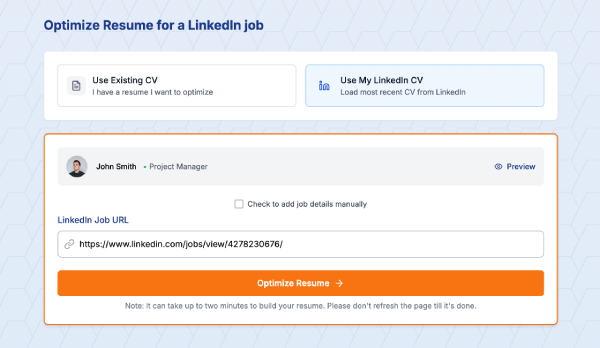
Linked CV Builder understands these role-specific requirements. You paste your LinkedIn profile, paste the job posting, and it generates a CV optimized for that specific role – product, engineering, marketing, whatever. The AI knows what metrics matter for each field, what keywords ATS systems are scanning for, and how to structure the content so it actually gets read.
Final Thoughts (and Yes, I Have Opinions)
Your CV is not your life story. It's a marketing document designed to get you an interview.
Most people write CVs like they're trying to capture every responsibility they've ever had. That's the wrong approach. You're trying to prove you can do this specific job better than the other candidates. Everything else is noise.
Cut ruthlessly. If a bullet point doesn't demonstrate a relevant skill or achievement, delete it. If a job from 10 years ago isn't relevant to where you're going, shrink it to one line or remove it entirely.
And here's maybe the most important thing: your CV should evolve with every application. The product manager CV you send to a fintech startup should emphasize different things than the one you send to an enterprise SaaS company. Same role, different context, different emphasis.
Is that more work? Yes. Does it dramatically improve your response rate? Also yes.
Stop sending the same generic CV to every job. Paste your LinkedIn profile link and build a tailored, ATS-optimized CV in minutes with Linked CV Builder. Your future self will thank you when you're choosing between offers instead of wondering why nobody's responding.
Written by Di Reshtei