Key Takeaways
- Generic CVs get filtered out by ATS systems before humans even see them.
- HR spends about 5 seconds on your CV – you need exact keyword matches.
- Tailoring doesn't mean rewriting everything. It's strategic tweaking.
- Tools exist now that do this in under a minute (because who has time?).
- Each job posting is a roadmap – use it.
Ready to stop wasting time? Paste your LinkedIn profile link and build an ATS-optimized CV in 5 minutes with Linked CV Builder.

Look, I get it. You spent hours crafting the perfect CV. Every bullet point polished, every achievement quantified. Why would you need to change it for every single job?
Because that perfect CV? It's probably getting rejected before a human even looks at it.
The Brutal Truth About Generic CVs
Here's what's happening behind the scenes. You hit "submit" on a job application and your CV enters this digital void where an ATS (Applicant Tracking System) scans it for keywords. If your CV doesn't match what the system's looking for, it gets buried. Doesn't matter how qualified you are.
Companies use these systems because they're drowning in applications. A single job posting can get 250+ resumes. No recruiter has time to read all of those, so the software does the first cut.
And the software is dumb. It's looking for exact matches. If the job says "project management" and your CV says "managing projects," you might get dinged. Seriously.
Why 2025 Changed Everything
The job market isn't what it was even two years ago. Competition's fierce. Remote work means you're competing globally now. And companies have gotten smarter – or lazier, depending on how you look at it – about filtering candidates.
One-size-fits-all doesn't work anymore. Maybe it never did, but now the consequences are immediate. Your generic CV might work for 1 out of 10 jobs you apply to. The other 9? Straight to the rejection pile.
I've seen people with incredible experience get ghosted because their CV didn't say "stakeholder engagement" when the job posting used that exact phrase. They had the experience! They just called it "working with clients."
The system doesn't care about synonyms.
What "Tailoring" Actually Means
Okay so you need to customize your CV. But what does that mean in practice?
It's not rewriting your entire work history. That would be insane and nobody has that kind of time. It's about strategic adjustments:
Match the keywords. Pull the key skills and requirements from the job posting and mirror that language in your CV. If they want "data visualization," use those exact words.
Reorder your skills section. Put the most relevant skills at the top. The ATS weighs placement, and so do humans in those crucial 5 seconds they spend scanning.
Adjust your summary or objective. This is prime real estate. Make it specific to the role you're applying for, not some vague "results-driven professional" nonsense.
Highlight relevant achievements. You probably have 10-15 bullet points under each job. Not all of them matter for every application. Emphasize the ones that align with what this particular employer wants.
Drop what doesn't fit. If you're applying for a marketing role, your brief stint as a restaurant server in college? Probably doesn't need three bullet points. Maybe one line, maybe cut it entirely.
The Reality Check: This Takes Time
And here's where it gets tricky. Tailoring works, but it's tedious as hell.
Let's say you apply to 5 jobs this week. That's 5 customized CVs. If you're doing it manually, you're looking at 20-30 minutes per CV, minimum. That's 2+ hours just on CV editing, not counting the actual job search, cover letters, or filling out those nightmare application forms that ask you to manually enter everything that's already on your CV.
For freelancers or contractors applying to multiple gigs daily? Forget it. You'd spend your entire day just reformatting documents.
This is why people don't do it. Or they do it halfway and wonder why they're not getting responses.
How to Actually Tailor Without Losing Your Mind
Start with a master CV. This is your complete work history, every skill, every achievement. Keep it comprehensive. It's your source document.
Create a job-specific version. Pull from the master CV but arrange it for the specific role. Think of it like a greatest hits album – you're not recording new songs, just picking the right tracks.
Use the job description as your guide. I mean really use it. Print it out, highlight it, whatever works. What are they asking for? What words do they keep using? That's your blueprint.
Focus on the top third of your CV. The summary, skills section, and your most recent role get the most attention. If you're short on time, optimize those parts first.
Keep a template library. After you've tailored CVs for a few different types of roles, save them. Applying for another marketing position? Start with your marketing-focused template and tweak from there.
The Tools That Changed the Game
I'm not going to pretend you should do all this manually. It's 2025. We have AI now.
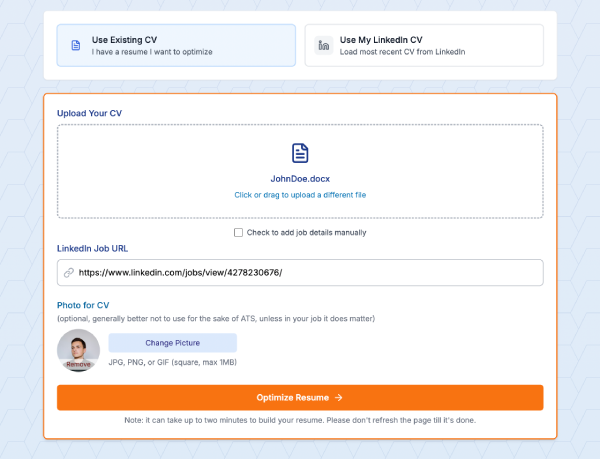
Tools like Linked CV Builder can scan a job posting and rewrite your CV to match in under a minute. You paste the LinkedIn job URL, it pulls the requirements, and adjusts your CV accordingly. The AI matches keywords, reorders sections, even generates a tailored cover letter.
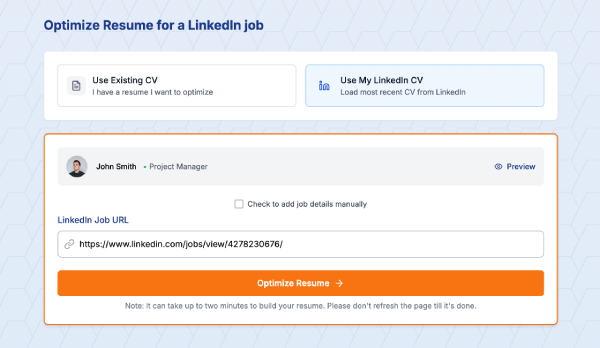
Is it perfect? No. You should still review it. But it handles the grunt work – the keyword matching, the formatting, the ATS optimization – so you can focus on the parts that need a human touch.
And look, if you're applying to 3-5 jobs a day, saving 25 minutes per application adds up fast. That's hours back in your week.
What ATS Systems Are Actually Looking For
Since we're playing this game, might as well understand the rules.
Keywords in context. Just stuffing keywords at the bottom of your CV doesn't work anymore. They need to appear naturally in your job descriptions and skills sections.
Standard formatting. Fancy graphics, tables, and creative layouts confuse ATS systems. Stick to clean, simple formatting with clear headers.
Standard section names. Call your work experience "Work Experience" or "Professional Experience," not "My Journey" or whatever. ATS systems look for standard headers.
Consistent dates and formatting. Use the same date format throughout (Month Year or MM/YYYY, pick one). Keep your formatting consistent.
File format matters. PDF is usually safe, but some older systems prefer .docx. Check the job posting for instructions.
The Cover Letter Problem
Yeah, you need to tailor those too.
Sorry.
The good news? If you've already customized your CV for the role, you've done most of the thinking. Your cover letter should reinforce the same themes, use similar keywords, and show you actually read the job description.
Generic cover letters are maybe worse than generic CVs because they're so obvious. "I am writing to express my interest in the position at your company" – immediate delete.
Better: "When I saw you're looking for someone to lead your SEO strategy during a rebrand, it reminded me of the work I did at [Company], where we increased organic traffic 340% during a similar transition."
Specific. Relevant. Shows you paid attention.
Common Mistakes That Kill Tailored CVs
Over-tailoring. Don't lie or claim skills you don't have just because they're in the job posting. You'll get caught in the interview.
Under-tailoring. Changing two words and calling it customized doesn't count. Put in actual effort.
Ignoring the company. Research the company culture, their recent news, their values. Weave that in where it makes sense.
Forgetting to proofread. You're making multiple versions of your CV. Easy to leave in references to the wrong company or role. Check everything.
Making it too long. Tailoring doesn't mean adding more. Often it means cutting what's irrelevant. Keep it to 1-2 pages.
Is It Worth It?
Short answer: yes.
Studies show tailored CVs can triple your response rate. That matches what Linked CV Builder users are reporting – 3X more recruiter responses.
Think about it. If you send out 20 generic CVs and get 1 response, that's a 5% success rate. If you send out 10 tailored CVs and get 3 responses, that's 30%. You're applying to fewer jobs but getting more results.
Quality over quantity actually works here.
The New Job Search Strategy
Here's what the smart job seekers are doing in 2025:
- They're applying to fewer jobs. 5-10 really good matches instead of 50 random ones.
- They're spending time on customization. Either manually or using tools to speed it up.
- They're tracking what works. Which customized CVs got responses? What keywords seemed to matter? They're treating it like an experiment.
- They're not precious about their "perfect" CV. They're willing to reshape it for each opportunity.
Final Thoughts
The generic CV is dead. Maybe it worked in 2015 when you could walk your resume into an office and hand it to the hiring manager. That doesn't happen anymore.
Now you're competing with algorithms first, humans second. And the algorithms are looking for exact matches.
Tailoring your CV isn't optional. It's the baseline. The question isn't whether you should do it, but how you'll find time to do it efficiently.
Because the jobs aren't going to get less competitive. The ATS systems aren't going away. And that five-second glance from HR isn't getting any longer.
You can spend hours doing this manually, or you can use tools that do it in minutes. Either way, you need to do it.
The people getting hired aren't necessarily more qualified. They're just better at showing they're the right fit for each specific role.
Stop sending the same CV to every job. Paste your LinkedIn profile link and build ATS-optimized, tailored CVs in 5 minutes with Linked CV Builder. Your future employer is waiting.
Written by Di Reshtei