Key Takeaways
- LinkedIn jobs need tailored CVs, not generic ones – recruiters spend just 5 seconds scanning.
- AI tools can match your LinkedIn profile to job requirements automatically.
- You can create job-specific resumes in under 5 minutes without manual rewriting.
- ATS optimization is non-negotiable for getting past automated filters.
- Paste your LinkedIn profile link – build ATS CV in 5 minutes with Linked CV Builder.

Look, I've sent out probably 50+ CVs on LinkedIn. Maybe more, honestly I lost count. And you know what kills me? The amount of time I wasted sending the same damn resume to completely different jobs.
Marketing coordinator role? Same CV. Senior data analyst position? Yep, same CV again.
Stupid, right?
The 5-Second Problem Nobody Talks About
Here's the thing that changed everything for me. Recruiters on LinkedIn – they're not reading your CV like it's a novel. They're skimming. Fast.
Five seconds. That's what you get.
In that time, they're scanning for keywords from the job post, looking for relevant experience, checking if your skills actually match what they need. If they don't see it immediately... next candidate. Your beautifully crafted "dynamic professional with a proven track record" opening? Wasted ink.
The brutal truth is this: a generic CV is basically invisible on LinkedIn in 2025.
Why Manual Tailoring Takes Forever (And Why You Probably Skip It)
I tried doing it the "right way" for a while. You know, reading the job description carefully, adjusting bullet points, adding keywords here and there, reordering sections.
Each application took 20-30 minutes minimum.
For one job.
When you're applying to 3-4 positions a day? That's two hours of tedious copy-pasting and rewording. By the third application I'd get sloppy, start cutting corners, forget to change the company name in my cover letter (yeah, did that once – never again).
Most people just... don't do it. They send the master CV and hope for the best. I get it, I really do. But that's exactly why response rates are so low.
The Actual 5-Minute Method
So here's what actually works now, and I'm not exaggerating the time frame.
Step 1: Have Your LinkedIn Profile Ready
If your LinkedIn is current, you're already 70% done. Make sure your experience, skills, and summary are up to date. This becomes your source material. Takes maybe 10 minutes if you haven't touched it in a while.
Step 2: Find the Job You Want
Browse LinkedIn jobs like normal. When you find something worth applying to, copy the job URL. That's it.
Step 3: Let AI Do the Heavy Lifting
This is where tools like Linked CV Builder come in. You paste your LinkedIn profile link. You paste the job URL. The AI reads both, figures out what the employer actually wants, and rewrites your CV to match.
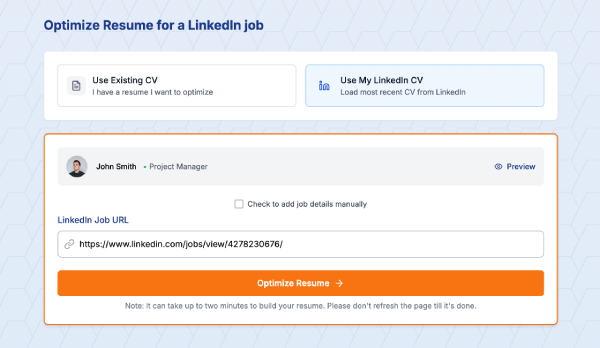
It pulls relevant skills you might've forgotten. It restructures your experience to highlight what matters for that specific role. It even generates a matching cover letter.
Time elapsed? Under 5 minutes. Sometimes closer to 2.
Step 4: Quick Review and Send
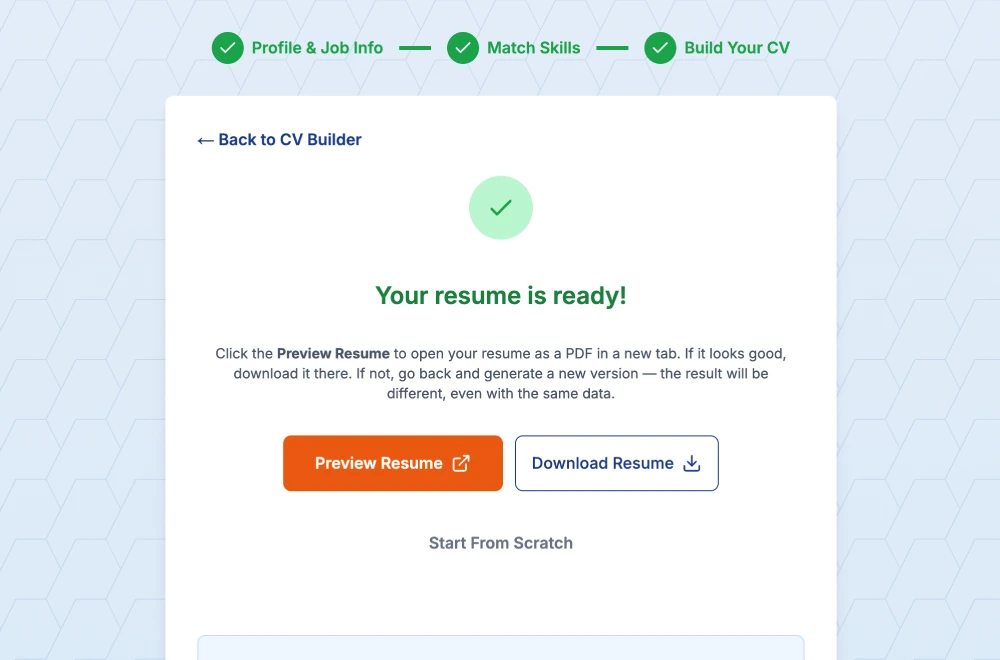
Download the tailored CV, scan it quickly to make sure nothing looks off (the AI is pretty accurate but you should always check), and submit. Done.
What Makes This Different from Just Using ChatGPT?
Fair question. I tried the ChatGPT route too – copying job descriptions, feeding them into prompts, asking it to rewrite sections.
It's better than nothing but it's clunky. You're still doing a lot of manual work. Copy this, paste that, format it properly, make sure it didn't hallucinate some skill you don't have.
Purpose-built tools analyze your actual LinkedIn profile (not just what you copy-paste into a chat), understand ATS requirements, use proven CV templates that recruiters actually respond to. The output is ready to submit, not a rough draft you need to clean up.
Plus they keep track of which version you sent where. Trust me, that matters when you're juggling multiple applications.
The ATS Reality Check
Here's something most people don't think about – ATS systems (Applicant Tracking Systems) are filtering you out before any human sees your CV.
These systems scan for keywords, parse formatting, check if your skills match the requirements. If your CV isn't optimized? Rejected automatically. You never had a chance.
A good tailoring tool handles this. It knows what ATS systems look for, formats everything correctly, includes the right keywords naturally (not just stuffing them in awkwardly). Your CV actually makes it through to a real person.
Real Talk: Is This Cheating?
I had this thought too at first. Like, am I being dishonest by using AI to tailor my CV?
But here's my take... you're not inventing fake experience. You're not lying about your skills. You're presenting the experience you actually have in a way that's relevant to each specific job.
That's not cheating. That's smart job hunting.
Every job is different. Every employer wants something slightly different. Why wouldn't you adjust your pitch accordingly? When you go to a job interview, you don't give the exact same canned answers to every company – you adapt based on who you're talking to and what they care about.
This is the same thing.
When It Actually Saves You
The time savings add up fast. If you're serious about your job search and applying to, say, 4 positions a week:
Old way: 20 minutes per application × 4 = 80 minutes/week
New way: 5 minutes per application × 4 = 20 minutes/week
That's an hour back in your week. And honestly? The 5-minute versions perform better because they're actually tailored, not half-assed adaptations you rushed through because you were tired.
I've talked to contractors and freelancers who apply to gigs daily. For them, this type of tool is basically essential. They're saving 30-60 minutes every single day.
The Cover Letter Bonus
Oh, and the cover letter thing? Super helpful.
I used to dread writing cover letters. Most of them felt generic and forced. But when an AI generates one based on your specific experience and the actual job requirements, it reads way more naturally. You still want to personalize it a bit, add your voice, but the heavy lifting is done.
Some jobs don't need cover letters anymore, sure. But when they do, having one ready in 30 seconds is pretty great.
Bottom Line
If you're applying to jobs on LinkedIn in 2025, you need tailored CVs. Not someday, not eventually – right now. The competition is too fierce and the tools recruiters use are too sophisticated for generic resumes to work anymore.
The good news? It doesn't have to be painful or time-consuming.
Find a tool that syncs with your LinkedIn profile, understands ATS requirements, and outputs job-specific CVs quickly. Use it. Your response rate will improve – mine went up noticeably within the first week.
Stop sending the same CV to every job. Start applying smarter, not harder.
P.S. – Most tools offer free trials or credits to test them out. Use those. See if the tailored CVs actually perform better for you. I think you'll be surprised at how much of a difference it makes.
Written by Di Reshtei