Key Takeaways
- Job descriptions are literal roadmaps for what keywords should be in your CV.
- ATS systems scan for exact matches, not "close enough" variations.
- Different companies use different terms for the same skills (and you need to know which ones they want).
- Strategic keyword placement matters more than keyword stuffing.
- One master CV doesn't cut it anymore – you need tailored versions.
Ready to stop guessing? Paste your LinkedIn profile link – build ATS CV in 5 minutes with Linked CV Builder.

Look, I'm gonna be real with you. Most people write their CV once, maybe twice in their career, and just... keep sending that same document everywhere. Then they wonder why they're getting ghosted by companies they're clearly qualified for.
The problem isn't you. It's that you're speaking a different language than the robots reading your CV.
The Brutal Truth About ATS Systems
Here's what actually happens when you submit your CV. A human doesn't read it first. An Applicant Tracking System does – and these systems are dumb as rocks. They're looking for exact keyword matches from the job description. Not synonyms. Not "basically the same thing." Exact. Matches.
You could have 10 years of experience in "client relations" but if the job posting says "customer success," the ATS might rank you lower than someone with 6 months who used the right term.
Frustrating? Yeah. But that's the game.
Step 1: Mine the Job Description Like You're Looking for Gold
Open that job posting. Read it like you're getting paid per word (you kinda are, actually).
You're looking for three types of keywords:
Hard skills – These are the technical requirements. Programming languages, software tools, certifications, methodologies. In a marketing role, this might be "Google Analytics," "SEO optimization," "A/B testing." For a project manager, you'd see "Agile," "Scrum," "stakeholder management."
Soft skills – The personality stuff. "Leadership," "collaboration," "problem-solving." Companies love these, even though everyone claims to have them.
Industry jargon – Every field has its own vocabulary. Legal tech talks about "e-discovery." Healthcare mentions "HIPAA compliance." Finance drops "regulatory reporting." You need to match their dialect.
Here's the thing though... don't just skim for bullet points. Read the actual paragraphs too. Sometimes the most important keywords are buried in sentences like "You'll be responsible for optimizing our CI/CD pipeline" – boom, there's your keyword: CI/CD pipeline.
Step 2: Make a Keyword List (It's More Art Than Science)
I usually open a Notes file and just start copying terms. Not organized, just dumping everything that seems relevant.
Then I go through and group them:
- Must-haves (they mention it 3+ times or it's in the job title).
- Nice-to-haves (mentioned once or twice).
- Industry context (shows you get the field, even if not required).
Some keywords deserve priority. If a job description says "required: Python" four times but mentions "nice to have: R" once... yeah, Python better be prominently featured in your CV.
Step 3: Match Your Experience to Their Language
This is where it gets interesting.
You're not lying. You're translating.
Let's say you "managed a team of content creators who produced blog posts and social media." The job description asks for someone who "oversees content strategy and digital marketing initiatives."
Your CV should say: "Directed content strategy across blog and social channels, leading a team of 5 creators to execute integrated digital marketing initiatives."
See what happened there? Same experience. Their words.
Another example – maybe you "helped customers solve technical problems." The job wants someone who "provides Tier 2 technical support and troubleshooting."
Rewrite it: "Delivered Tier 2 technical support, troubleshooting complex issues for enterprise customers."
You did the work. Just describe it in the terms they're searching for.
Step 4: Placement Strategy (Because Location Matters)
Okay so you've got your keywords. Where do they go?
Your professional summary – This is prime real estate. ATS systems often weigh this section heavily. Pack your top 5-7 keywords here naturally. "Marketing professional with expertise in SEO optimization, content strategy, and Google Analytics..."
Job titles and company descriptions – If your actual title was "Client Specialist" but you did account management work, you can write: "Client Specialist (Account Management role)." Gives context for the ATS.
Bullet points – Start your achievement bullets with action verbs, but weave keywords throughout. "Developed Python scripts that automated data analysis workflows, reducing processing time by 40%."
Skills section – Just list them. Seriously, this is where you can almost keyword-stuff without it looking weird. "Technical Skills: Python, SQL, Tableau, AWS, Machine Learning, Data Visualization"
One trick I've seen work: if they mention a skill with specific capitalization or phrasing (like "JavaScript" vs "Javascript"), match it exactly. Some ATS are that literal.
Step 5: The Verification Step Nobody Does
Before you submit, do this.
Copy the job description. Paste it into a word cloud generator (there's free ones online). See which words appear most frequently.
Now do the same with your tailored CV.
Do they look similar? They should.
If the job description's word cloud has "data analysis" huge and your CV's word cloud barely shows it... you've got work to do.
Common Mistakes That'll Sink You
Keyword stuffing – Writing "Python Python Python" at the bottom in white text. C'mon. ATS can detect this garbage, and when a human finally sees it, you look ridiculous.
Using only synonyms – You say "fiscal management," they want "budget management." Close, but not the same to a computer.
Ignoring soft skills – Yeah, ATS scans for "leadership" and "communication" too. Don't skip them because they feel generic.
One CV for everything – I know it's annoying. But sending the same CV to a "Marketing Manager" role and a "Growth Marketing Lead" role is lazy. They use different keywords. Tailor both.
The Reality Check
Does this take time? Yes. Is it annoying? Absolutely.
But here's what I tell people – you can spend 2 hours tailoring 5 CVs for jobs you actually want, or you can spend 5 minutes sending one generic CV to 50 jobs and get zero responses.
One approach is strategic. The other is just... spam.
And honestly? Once you've done this a few times, you get faster. You build a library of descriptions for your experience. You know which keywords matter in your industry. It becomes almost automatic.
Tools That Actually Help
Look, you can do this manually. Open the job description in one window, your CV in another, copy-paste keywords... sure.
Or you can use tools that were literally built for this. Linked CV Builder pulls your LinkedIn profile and matches it against job descriptions automatically. It suggests which keywords you're missing, rewrites sections to match the job's language, and gives you an ATS optimization score.
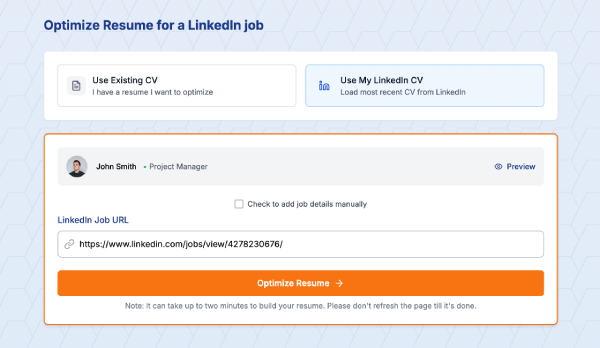
I'm not saying you can't do this by hand. But why would you want to spend an hour on something that takes 5 minutes?
The tool basically does what I just explained – scans the job posting, extracts keywords, cross-references with your experience, and generates a tailored CV. Plus a cover letter that actually mentions the company's specific requirements instead of generic nonsense.
Final Thoughts (Because Every Article Needs an Ending)
The job market's weird right now. You're competing with hundreds of applicants, and most of them aren't even making it past the ATS stage – not because they're unqualified, but because they're speaking the wrong language.
Job descriptions aren't just postings. They're answer keys.
Use them.
Every keyword they mention is a hint about what the ATS is scanning for. Every repeated phrase is a priority signal. Every specific tool or methodology they name is something that should probably appear in your CV if you've actually used it.
This isn't about gaming the system. It's about making sure the system actually sees your qualifications instead of filtering you out before a human ever looks.
So next time you're applying – before you hit submit – pull up that job description one more time. Check your keywords. Make sure you're speaking their language.
Or just let the AI do it. Either way, stop sending that generic CV.
Stop wasting time rewriting your CV manually. Paste your LinkedIn profile link – build ATS CV in 5 minutes with Linked CV Builder.
Written by Di Reshtei