Key Takeaways
- Generic CVs get 40-60% fewer responses from recruiters compared to tailored ones.
- Job-specific CVs pass ATS filters 3x more often than one-size-fits-all versions.
- Tailoring takes 5 minutes with the right tools but can add weeks to your job search timeline.
- Real case studies show 300% improvement in interview callbacks with customized resumes.
- Most rejected candidates had the right skills – they just didn't present them correctly.
Ready to stop wasting time on applications that go nowhere? Paste your LinkedIn profile link and build an ATS-optimized CV in 5 minutes with Linked CV Builder.

Look, I'm gonna be straight with you. That "master CV" you've been sending to every job posting? It's killing your chances.
I know what you're thinking – "But I spent THREE DAYS perfecting that resume!" Yeah, and HR spent 5 seconds scanning it before hitting delete. Maybe less.
The thing is, hiring managers aren't reading your CV like it's a novel. They're skimming for keywords, specific experiences, exact skill matches. And if your generic resume doesn't scream "I'm perfect for THIS job," you're out.
What Makes a CV "Generic" (And Why It's Sabotaging You)
A generic CV tries to be everything to everyone. Big mistake.
It lists every single skill you've ever learned. Every project from 2015. That random certification you got because your boss made you. It's comprehensive, sure... but also completely unfocused.
Here's what a generic CV looks like in practice:
Generic CV Example – Marketing Professional:
Professional Summary: "Experienced marketing professional with strong communication skills and a proven track record of success. Skilled in digital marketing, social media, content creation, and analytics. Team player with excellent organizational abilities."
Skills: SEO, SEM, Content Marketing, Social Media Marketing, Email Marketing, Analytics, Project Management, Communication, Leadership, Microsoft Office, Adobe Creative Suite, CRM Software
See the problem? This could be anyone. There's nothing here that connects to a specific role or company need. It's just... words. Boring, safe, forgettable words.
And the ATS (Applicant Tracking System) software? It's confused as hell because you've listed 47 skills but the job posting only asked for 8 specific ones.
The Job-Specific Approach Actually Works
Now let's talk about what happens when you tailor that same CV for a specific Content Marketing Manager role at a SaaS company.
Job-Specific CV Example – Same Person, Different Approach:
Professional Summary: "Content Marketing Manager with 5 years driving organic growth for B2B SaaS companies. Increased blog traffic by 340% and generated 2,400+ qualified leads through strategic content initiatives at previous role. Experienced in full-funnel content strategy, SEO optimization, and cross-functional collaboration with product and sales teams."
Core Skills: B2B Content Strategy • SEO & Organic Growth • Lead Generation • SaaS Marketing • HubSpot & Marketing Automation
Notice the difference? This version speaks directly to what the employer needs. It's specific, measurable, focused.
The job posting mentioned "SaaS experience" – boom, it's right there. They wanted someone who could drive organic traffic – here are the actual numbers. They use HubSpot – guess what's in the skills section?
Real Results: The Data Doesn't Lie
Let me share some actual case studies because honestly, the numbers are kind of wild.
Case Study 1: Jennifer M. – Marketing Manager
- Generic CV: 23 applications sent, 0 responses (yeah, zero).
- Job-Specific CVs: 15 applications sent, 3 HR calls, 1 job offer.
- Time difference: She spent about 5 extra minutes per application.
Jennifer told us: "I was starting to think something was wrong with me. Turns out my resume just wasn't speaking their language."
Case Study 2: Jeremy C. – Software Engineer
- Generic CV: 89 applications over 3 months, 4 interviews.
- Tailored approach: 41 applications over 6 weeks, 12 interviews, 2 offers.
- Response rate jumped from 4.5% to 29%.
Jeremy's insight? "I had all the right experience. I just wasn't highlighting what each specific company cared about."
Case Study 3: Helen B. – Independent Contractor
Helen applies to multiple gigs daily. She was manually rewriting her CV and it was eating up 2+ hours every single day. After switching to tailored CVs for each application:
- Saves 30-60 minutes daily.
- Rejection rate dropped by roughly half.
- Actually has time to apply to MORE opportunities.
Why ATS Systems Murder Generic CVs
Let's get technical for a second – but I promise I'll keep it simple.
ATS software scans your CV looking for keyword matches with the job description. It's not smart enough to understand that "managed cross-functional teams" is basically the same as "led collaborative initiatives." It sees different words, scores you lower, and moves on.
A generic CV might mention "project management" once. But if the job posting mentions "project coordination," "timeline management," and "stakeholder communication" separately... you're missing three keyword opportunities.
Job-specific CVs mirror the language in the posting. Not in a creepy copy-paste way, but strategically. If they say "customer success," you say "customer success" – not "client satisfaction" or "customer service."
This isn't gaming the system. It's speaking the same language as your potential employer.
The Skills Section Trap
Here's where most people screw up their generic CV: the skills section becomes a dumping ground.
"I'll just list EVERYTHING I know and let them pick what they like!"
Wrong.
When you list 30+ skills, you look unfocused. Maybe desperate. The hiring manager thinks: "This person doesn't know what they want" or "They're probably mediocre at all of these."
A targeted skills section might have 6-8 items. That's it. But they're the EXACT skills mentioned in the job posting, plus maybe one or two related ones that show you understand the broader context.
Generic Skills Section:
Python, Java, C++, JavaScript, Ruby, HTML, CSS
SQL, MongoDB, PostgreSQL, Redis
AWS, Azure, Google Cloud
Docker, Kubernetes
Agile, Scrum, Kanban
Git, Jenkins, CI/CD
Job-Specific Skills Section (for a Python Backend Developer role):
Python (Django, Flask) • PostgreSQL • RESTful API Design
AWS (EC2, S3, Lambda) • Docker & Kubernetes • CI/CD with GitHub Actions
See how the second one is cleaner? More confident? It says "I know exactly what you need, and I have it."
But Doesn't Tailoring Take Forever?
Okay, this is the objection I hear most often. "Sure, customized CVs work better, but I don't have TIME to rewrite my resume for every application!"
Fair point. If you're doing it manually, yeah, it's brutal.
But here's the thing – you don't need to rewrite from scratch every time. You need to adjust maybe 20-30% of the content. Your work experience doesn't change. Your education doesn't change. What changes is:
- The summary (2 minutes to rewrite).
- The skills section (1 minute to reorder/adjust).
- Bullet point emphasis (2 minutes to highlight relevant projects).
That's 5 minutes. Maybe 10 if you're being thorough.
And honestly? Tools exist now that do this automatically. You paste the job posting URL, and AI rewrites your CV to match in under a minute. Linked CV Builder literally pulls from your LinkedIn profile and customizes everything based on the job requirements.
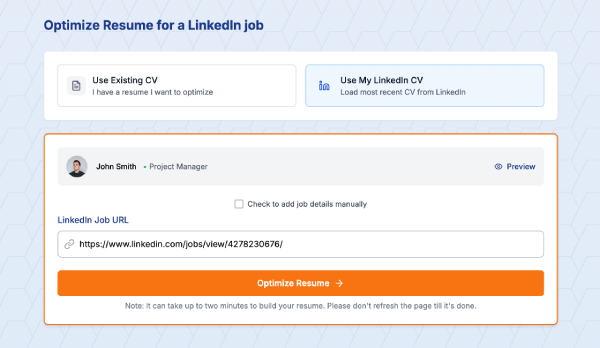
Is it perfect? Maybe not. But it's 95% of the way there, and you can tweak the last 5% if you want.
The Cover Letter Problem (Same Story)
Generic cover letters are even worse than generic CVs.
"I am writing to express my interest in the open position at your company. I am a dedicated professional with strong skills and a passion for excellence..."
Kill me now.
Every hiring manager has read this exact letter 1,000 times. It says nothing. Absolutely nothing.
A job-specific cover letter mentions:
- The actual job title and company name (shocking, I know).
- Specific challenges the company is facing that you can help solve.
- Examples from your experience that directly relate to their needs.
- Why THIS company, not just "a company like this".
When you tailor a cover letter, you're showing you actually read the job posting. You did research. You care enough to spend 10 minutes customizing instead of blasting the same template everywhere.
Common Mistakes Even With "Tailored" CVs
Alright, so you're convinced. You're gonna start tailoring. Great! But watch out for these traps:
Mistake 1: Keyword Stuffing
Don't just cram every word from the job posting into your CV. ATS systems are getting smarter, and humans definitely notice when you write "utilized synergistic approaches to optimize stakeholder engagement" five times.
Mistake 2: Lying About Experience
Tailoring doesn't mean making stuff up. If the job requires Python and you don't know Python... learn Python, or apply to different jobs. Don't put "Python" on your CV and hope they won't ask about it.
Mistake 3: Forgetting the Human Reader
Yes, you need to pass the ATS. But eventually a person reads your CV. If it's stuffed with keywords but reads like robot vomit, you're not getting the interview.
Mistake 4: Using the Wrong Template
Some CV templates are ATS poison. Complex formatting, tables, graphics, columns – these confuse the parsing software. Stick with clean, simple layouts. Tested ATS-friendly templates exist for a reason.
The Math That Should Convince You
Let's do some quick calculations.
Scenario A: Generic CV
- Time per application: 5 minutes (just sending).
- Applications sent: 100.
- Response rate: 3%.
- Interviews: 3.
- Total time: 500 minutes (8.3 hours).
Scenario B: Tailored CVs
- Time per application: 15 minutes (10 extra for customization).
- Applications sent: 50.
- Response rate: 12%.
- Interviews: 6.
- Total time: 750 minutes (12.5 hours).
Scenario B takes 4 more hours but gets you DOUBLE the interviews. And in reality, most people find jobs faster with the tailored approach because those interviews are higher quality – you're applying to jobs you actually fit.
Plus, sending 100 applications and hearing nothing back? That's soul-crushing. I'd rather spend the extra time and actually see results.
What About Career Changers?
"But I'm switching industries! How do I tailor when I don't have direct experience?"
Great question. This is where tailoring becomes even MORE important.
You focus on transferable skills. You reframe your experience in the new industry's language. You emphasize projects that relate, even tangentially.
Example: Teacher Moving to Corporate Training
Generic bullet point: "Developed and delivered curriculum for high school English classes"
Tailored bullet point: "Designed and facilitated learning programs for diverse audiences of 30+ participants, adapting content delivery based on individual learning styles and assessment results"
Same experience. Different framing. One sounds like a teacher, the other sounds like a corporate trainer.
Tools vs. Manual Work: What's Actually Worth It?
I'll be honest – I'm lazy. If a tool can do 90% of the work in 60 seconds, I'm using the tool.
But some people insist on doing everything manually because they want "full control." Cool, go for it. You'll spend 30 minutes per application instead of 5.
The best approach? Use automation for the heavy lifting, then manually review and adjust. Tools like Linked CV Builder pull from your LinkedIn, match it against the job posting, and generate a tailored CV. Then you spend 2-3 minutes tweaking anything that feels off.
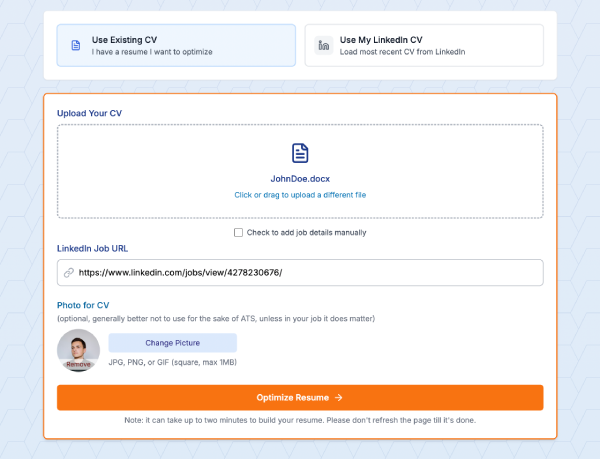
This is what Helen (the contractor from earlier) does. She told us: "I was skeptical at first, but after seeing how much time it saved AND how much better my results got... I'm never going back."
The Brutal Truth About Job Hunting in 2025
The market is competitive. Remote work means you're competing globally. AI is making it easier to apply to jobs, so employers are getting FLOODED with applications.
The only way to stand out? Be specific. Be relevant. Be exactly what they're looking for.
Generic CVs made sense 15 years ago when you printed them out and handed them to a person. Now they're parsed by software, filtered by algorithms, and skimmed by overworked HR managers in 5 seconds.
You need every advantage you can get.
Your Action Plan (Do This Today)
- Stop sending your generic CV immediately. Just stop.
- Pick ONE job you really want. Read the posting carefully.
- Create a tailored version of your CV for that job. Even if it takes you 30 minutes, do it properly.
- Apply with the tailored version.
- Notice how much better it feels to send an application you're actually proud of.
- Repeat for every job you care about.
Or, if you want to skip the manual work and get back to your life, paste your LinkedIn profile into Linked CV Builder and let AI handle the customization. Either way, just stop sending that generic resume into the void.
The Reality Check
I've talked to hundreds of job seekers. The ones who land interviews consistently? They tailor their applications.
The ones who send 200+ applications with no responses? They're using the same generic CV for everything.
It's not about your qualifications. It's about presentation. About speaking the employer's language. About showing you understand what they need and can deliver it.
Generic CVs are the job search equivalent of using a megaphone in a crowded room. Everyone hears you, but nobody is listening.
Tailored CVs are like walking up to someone and having a direct conversation. It takes more effort, but it actually works.
Stop wasting time on applications that go nowhere. Get an ATS-optimized, job-specific CV in 5 minutes. Paste your LinkedIn profile here and try it now →
Written by Di Reshtei